Simplifying Cisco VoIP/UC monitoring with ServicePilot
The growing complexity of VoIP and UC solutions
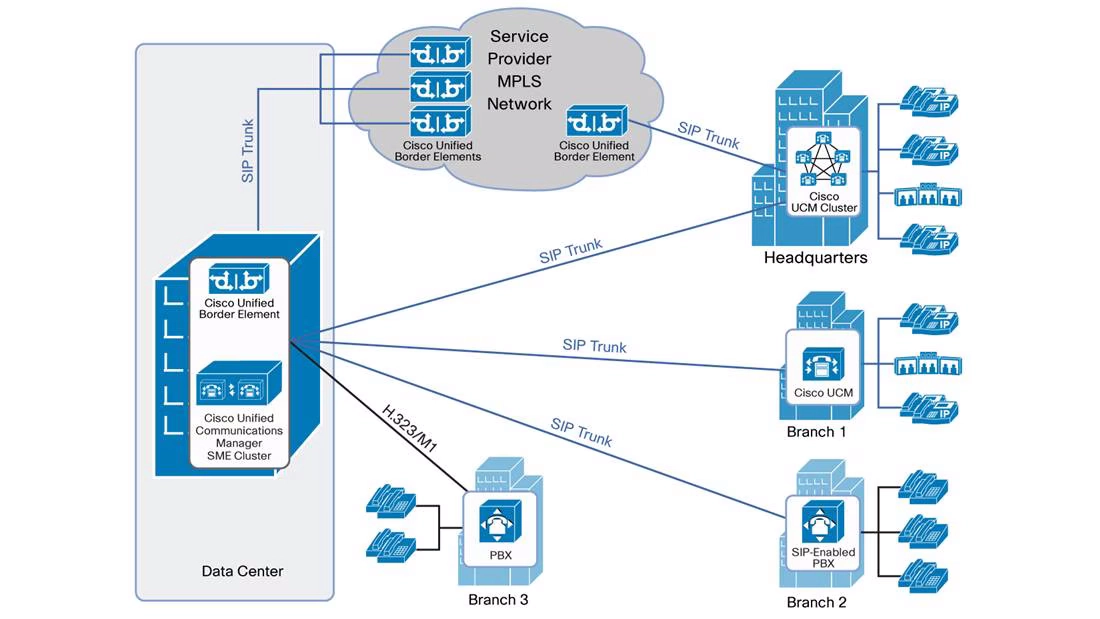
The growing complexity of Cisco’s VoIP and UC solutions is not due to a single factor. It is the result of a combination of technological transformations, changes in usage patterns and business requirements that have made these environments much more difficult to monitor.
Explosion in usage and diversification of endpoints
Originally, Cisco VoIP relied primarily on fixed IP phones connected to the LAN. Today, unified communications encompasses: Softphones on PCs, mobile apps (Cisco Jabber, Webex, Teams, etc.), multi-model IP phones, USB/Bluetooth headsets, video conferencing, meeting rooms, Webex or Teams endpoints, remote work and even calls via VPN, Wi-Fi or 4G/5G. Each endpoint introduces additional variables: Network quality, codecs, compatibility, mobility, roaming and more. Greater diversity means more potential points of failure.
Migration to hybrid and cloud architectures
Cisco Unified Communications is no longer exclusively on-premises but now includes hybrid and cloud architectures. Companies are adopting Webex Calling or Teams, hybrid CUCMs, cloud SBCs or cloud SIP providers. This hybridization multiplies the number of data flows, dependencies and areas where an incident can occur. Monitoring extends far beyond the LAN and WAN, which complicates everything.
Proliferation of codecs and quality requirements
Today’s VoIP environments use several codecs: G.711, G.729, Opus, video codecs (H.264, H.265…), adaptive codecs for Webex… Each codec has its own constraints in terms of bandwidth, jitter, latency, packet loss and dynamic adaptation.
Dynamic, segmented and sensitive networks
Modern networks and UC infrastructures are segmented (VoIP VLANs, guest VLANs, SD-WAN, etc.), virtualized (VMware, Hyper-V, containers), mobile (Wi-Fi, roaming, 5G), optimized via advanced QoS and distributed across multiple sites. VoIP relies heavily on network stability and the more complex the network, the more granular and correlated VoIP monitoring must be.
Increasing number of Cisco UC services to monitor
A comprehensive Cisco UC environment may include a multitude of components to monitor: CUCM, CUC (voicemail), CUBE, IM&P, Expressway, Webex, gateways, carrier SBCs, media servers, ancillary services (TFTP, CTI, DB, SIP, RTP…), etc. Each service must be monitored individually and in relation to the others. Monitoring must be comprehensive, correlated and intelligent.
Simplifying Cisco VoIP/UC monitoring
The quality of Cisco’s IP telephony and unified communications (UC) solutions is a strategic priority for businesses. From internal calls and video conferences to mobility and customer interactions, even the slightest issue with latency, jitter or service availability can directly impact productivity. This is especially true as user expectations have risen: Zero downtime, HD audio and video quality, seamless screen sharing, mobility, CRM and call center integration and more.
To ensure an optimal experience, IT teams must have complete, real-time visibility into the entire VoIP/UC infrastructure. This is precisely where ServicePilot delivers unique value: Unified, automated and intelligent monitoring of Cisco Unified Communications environments.
The challenges of Cisco VoIP/UC monitoring
Beyond the growing complexity of VoIP/UC environments, monitoring a Cisco UC environment requires understanding a multitude of different elements:
- A distributed architecture: CUCM, CUC, CUBE, gateways, endpoints, SBCs, media servers, etc.
- Multiple metrics: MOS, jitter, latency, packet loss, service availability, CPU load, memory, SIP sessions…
- Network dependencies: QoS, VoIP VLANs, WAN/MPLS, Wi-Fi, VPN.
- Complex traffic flows: Internal, external and inter-site calls, Webex, softphones and mobile devices.
There is a strong need for responsiveness: A VoIP incident must be detected and resolved immediately. Without a centralized platform, correlating data becomes difficult, if not impossible.
ServicePilot: Turnkey Cisco VoIP/UC monitoring
ServicePilot offers a unique approach to simplifying the monitoring of Cisco UC environments:
✔ Automatic discovery of infrastructure and components
Using its ready-to-use templates, ServicePilot automatically monitors:
- Cisco Unified Communications Manager (CUCM)
- Cisco Unity Connection (CUC)
- Cisco Unified Border Element (CUBE)
- Cisco Voice Gateways
- Media servers and related components
Each element is integrated into a semi-dynamic, customizable topological view, making it easier to understand dependencies.
✔ Advanced VoIP metrics collection
ServicePilot collects all essential metrics:
- CPU/memory load on UC servers
- Status of Cisco services and infrastructure
- Active SIP sessions
- MOS, jitter, latency, packet loss
- Call quality by site or by user
- Call statistics (successful, failed, abandoned)
The data is archived and can be viewed in ready-to-use dashboards. In addition to the standard dashboards associated with deployed packages, IT teams can create new ones to tailor the visualizations to the company’s needs.
✔ Intelligent analysis and practical alerts
ServicePilot’s algorithms enable:
- Automatic detection of quality degradation
- Alerts when thresholds are exceeded (MOS, latency, unavailable services, etc.)
- Identification of root causes (Root Cause Analysis)
- Correlation between network incidents and VoIP incidents
The goal: To drastically reduce mean time to resolution (MTTR).
Monitoring the quality of Cisco Meeting Server (CMS) meetings
Cisco Meeting Server has become a key component of Cisco UC infrastructures: Internal meetings, cross-site videoconferences, collaboration with external partners, WebRTC integration and more. But this wealth of functionality comes with increasing complexity and IT teams must monitor a large number of metrics to ensure a seamless experience.
ServicePilot simplifies this monitoring by automatically collecting essential CMS metrics:
- CPU and memory load on CMS servers
- Active sessions (SIP, WebRTC, Lync/Skype interoperability)
- Number of participants per meeting
- Media stream quality (latency, jitter, RTP packet loss)
- Status of CMS services (Call Bridge, XMPP, Web Bridge, Database, etc.)
ServicePilot offers ready-to-use dashboards:
- Overview of the CMS cluster’s status
- Real-time meeting quality
- Trend analysis (activity spikes, saturation, incident recurrence)
These dashboards provide a quick understanding of the platform’s status and help anticipate capacity needs. Thanks to automatic correlation between network, server and UC metrics, IT teams can take action before users report poor video quality or audio dropouts.
Why choose ServicePilot for Cisco UC monitoring?
All-in-one solution
ServicePilot monitors Cisco communication infrastructure and call quality metrics but also covers other resources that may impact unified communications:
- The network (LAN/WAN/Wi-Fi)
- Servers
- Applications
- Cloud resources
This comprehensive view is essential for understanding the causes of VoIP incidents.
Quick deployment
Cisco UC templates are ready to use: No complex configuration, no manual integration.
Complete visibility
ServicePilot provides monitoring that is:
- Technical (VoIP metrics, UC services)
- Functional (call quality, availability)
- Operational (alerts, SLAs, reporting)
Reduced MTTR
Thanks to intelligent correlation, IT teams save valuable time.
Monitoring Cisco VoIP/UC is critical to ensuring smooth and reliable communication within organizations. With ServicePilot, IT teams have a comprehensive, automated and intelligent solution to monitor the entire Cisco UC ecosystem, detect incidents before they impact users and optimize communication quality.
