Understanding SBC: Features, key metrics and monitoring
What is a SBC?
Unified communications have become an essential pillar of modern business operations. Between IP telephony, video conferencing, hybrid communications and cloud integration with platforms like Teams, Zoom or Webex, technical complexity is on the rise and with it, the risk of service degradation. At the heart of this architecture lies an often-overlooked but indispensable component: the Session Border Controller (SBC).
In this article, we will clarify the role of SBCs, explain why monitoring them is crucial and show how ServicePilot enables comprehensive, simple and effective monitoring.
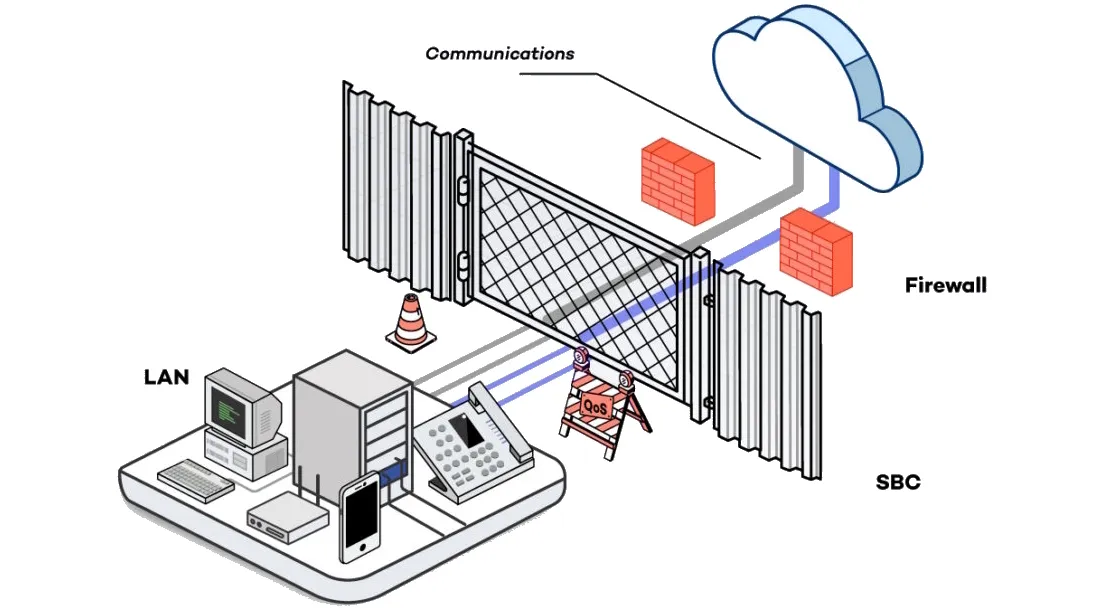
A SBC is a specialized network device that secures, controls and optimizes SIP communications. It is positioned at the boundary between two networks: internal/external, carrier/enterprise or cloud/on-premise.
The term session refers to a communication exchange between two or more parties and in a telephony context, it simply means a call.
Each call consists of:
- A set of SIP signaling messages used to establish, modify and terminate the communication
- One or more RTP media streams carrying voice, video or other data, accompanied by information on quality and transmission statistics
All of these data flows together constitute a session. The role of a Session Border Controller is to manage these data flows to ensure their security, consistency and quality.
The term border refers to a network boundary, that is, a point of separation between two distinct segments. A simple example is a firewall placed at the boundary between a company’s internal network and the Internet. In more complex environments (large enterprises, multi-site setups, segmentation by department or data type) multiple boundaries coexist, each requiring specific security and control rules.
The SBC specifically intervenes to manage and enforce session traffic policies across these boundaries.
Finally, the term controller refers to the SBC’s ability to influence, filter, transform or measure the traffic flows that make up a session as they cross these boundaries.
A SBC can therefore:
- Enforce access rules
- Control call permissions
- Perform protocol or codec conversions
- Provide detailed metrics on call quality and behavior
- Protect the infrastructure against SIP attacks or fraudulent use
In summary, a SBC is a strategic control point that secures, standardizes and monitors real-time communications within a modern VoIP architecture. It is therefore a critical gateway: if it malfunctions, the entire telephony system is affected. SBCs ensure the security, standardization and quality of voice / video streams.
What are the functions of a SBC?
A Session Border Controller provides a set of essential functions to secure, control and optimize SIP communications.
To understand its role, you must first grasp a few fundamental concepts:
- SIP Sessions - the process of establishing, maintaining and terminating calls
- RTP streams - the transport of voice, video or other media in real time
- Hidden topology - a mechanism for masking network addresses and internal network structure
- Transcoding - the conversion of codecs to ensure compatibility between heterogeneous devices
Based on these concepts, a SBC performs four main categories of functions.
Security
The SBC serves as the first line of defense for SIP communications. It protects the infrastructure against:
- Attacks targeting SIP signaling (scanning, fuzzing, flooding)
- Telephone fraud attempts
- DoS/DDoS attacks
- Unauthorized access via authentication and filtering mechanisms
It acts as a specialized VoIP firewall, capable of analyzing and filtering SIP messages and RTP streams.
Session control
The SBC manages the entire call lifecycle:
- Intelligent routing based on rules, carriers or user profiles
- Normalization and manipulation of SIP headers
- Management of concurrent sessions and capacity limits
- Load balancing between trunks or peer SBCs
It ensures that every session is properly established, maintained and terminated, even in complex multi-carrier environments.
Quality of Service (QoS)
To ensure an optimal experience, the SBC:
- Adapts codecs based on endpoint capabilities
- Manages bandwidth and prioritizes sensitive traffic
- Monitors quality metrics in real time (MOS, jitter, packet loss)
- Optimizes RTP streams based on network conditions
It plays a key role in call quality, particularly in WAN or cloud environments.
Interoperability
Modern VoIP infrastructures are often heterogeneous: multiple operators, various PBX systems, cloud platforms (Teams, Zoom, Webex) and diverse SIP endpoints.
The SBC ensures:
- Translation between protocols or SIP variants
- Compatibility between codecs
- Consistency in signaling rules
- Management of operator-specific features
It therefore acts as an interconnection bridge, ensuring seamless communications.
Leading SBC vendors
Without SBCs, enterprise communications would be more vulnerable to attacks, less reliable in terms of quality, difficult to interconnect across heterogeneous systems and complex to manage and troubleshoot.
The SBC is therefore a strategic component of any modern VoIP architecture.
The Session Border Controller market is dominated by a few major players, each with its own technical specifications, historical strengths and preferred use cases. Although the basic features are similar (SIP security, session control, QoS, interoperability), technological approaches and advanced capabilities vary significantly from one manufacturer to another.
The SBC market is dominated by a few major players:
- Oracle Communications (formerly Acme Packet)
- AudioCodes
- Ribbon Communications (formerly Sonus)
- Cisco
- Avaya
Monitoring Oracle SBCs with ServicePilot
A SBC is a critical component: if it goes down, the entire telephony system stops. Its monitoring must therefore be proactive, granular and correlated with the rest of the infrastructure. Oracle remains a benchmark for carrier environments and large enterprises requiring high availability and advanced metric granularity.
Collecting performance data from an Oracle SBC rests on three pillars:
A. System resource monitoring
ServicePilot monitors:
- CPU / memory
- Active sessions
- Maximum sessions
- Interface usage
- Status of HA (High Availability) peers
B. Collection of metrics with CDR
Oracle CDRs contain detailed information about each call:
- Origin / destination
- Duration
- Reason for call termination (SIP BYE, 4xx/5xx/6xx error)
- Codec used
- Trunk used
- Associated RTP statistics
ServicePilot extracts and structures this data to enable:
- Analysis of failure causes
- Monitoring of call volumes
- Detection of routing anomalies
- Correlation with trunks and carriers
C. QoS and call quality metrics
Oracle CDR also expose essential metrics:
- MOS (Mean Opinion Score)
- Jitter
- Packet loss
- Round Trip Delay
- RTP out-of-order
ServicePilot collects these in real time and logs them to:
- Detect quality degradation
- Identify problematic trunks
- Correlate network ↔ SBC ↔ carrier
- Optimize capacity
Beyond simple data collection
Where ServicePilot excels, in addition to data collection, is in how it presents this data through maps, dashboards and advanced correlation of VoIP architectures.
ServicePilot dashboards provide:
- An overview of SBC health
- Analysis of SIP errors
- Monitoring of trunks and carriers
- Call quality heatmaps
- Time-series analysis of CDRs
The goal: to enable IT teams to see at a glance what is going on.
Smart correlation with the rest of the infrastructure
A SBC never stands alone. ServicePilot enables correlation with:
- Network switches and routers (LAN / WAN)
- SIP providers
- PBX / IPBX
- Teams / Zoom / Webex
- Firewalls
This comprehensive view speeds up diagnostics and drastically reduces mean time to resolution.
Real-world use cases with ServicePilot
🔉 Deterioration in call quality on a carrier trunk
When a drop in quality occurs on a SIP trunk, ServicePilot automatically analyzes the entire VoIP chain to identify the root cause. Through intelligent metric correlation, the platform highlights symptoms characteristic of network or carrier degradation.
ServicePilot specifically correlates:
- Low MOS indicating a poor user experience
- High jitter revealing network instability
- Packet loss on the WAN interface directly impacting RTP streams
- SIP 503 errors signaling operator-side unavailability
Result: An immediate diagnosis pointing to a carrier failure, enabling the opening of a support ticket with precise technical evidence.
📈 Session overload on a SBC
During periods of high activity, a SBC can reach its capacity limits. ServicePilot continuously monitors critical resources and issue alerts before saturation impacts communications.
ServicePilot detects:
- Active sessions nearing maximum capacity
- Rising CPU usage, a sign of intensive traffic processing
- SIP 486/487 errors, typical of saturation or call rejection
The platform highlights peaks in activity, workload trends and helps identify key areas for optimization.
Result: Recommendations for scaling, load balancing or adding capacity before user experience dropped calls.
🔀 SIP routing issues
SIP routing errors are often difficult to diagnose without detailed visibility into CDRs. ServicePilot leverages this data to identify configuration inconsistencies or carrier failures.
Using detailed CDRs, ServicePilot highlights:
- Failed outbound calls to a specific carrier
- Recurring SIP 404 or 503 codes
- An unsolicited secondary trunk, despite a configuration intended to provide redundancy
Result: Rapid correction of routing rules, reactivation of redundancy and restoration of service availability.
Monitoring your SBCs means controlling your communications
SBCs are an essential link in the modern communication chain. Understanding and effectively monitoring them is essential to ensuring security, performance and availability. Their rich functionality comes with significant operational complexity.
Understanding CDR metrics, QoS indicators and call quality measurements is essential to guarantee performance, security and availability.
With ServicePilot, monitoring SBCs such as Oracle's becomes:
- Simple thanks to ready-to-use packages
- Comprehensive thanks to CDR, QoS and system data collection
- Correlated with the network, carriers and UC platforms
- Actionable thanks to intelligent alerts and technical dashboards
With ServicePilot, you benefit from an ideal solution to monitor your SBCs and anticipate issues before they impact your users.
